Colour blindness: types, tests and living with it
By See Better · Updated · 5 min read
The short answer
Colour blindness, properly called colour vision deficiency, is difficulty telling certain colours apart, most often reds and greens. It is usually inherited and affects about 1 in 12 men and 1 in 200 women. Most people with it see plenty of colour, just a narrower range. It is found with a simple test and cannot be cured, but people adapt well.
Key points
- Red-green deficiency is by far the most common type, and it is much more common in males.
- Very few colour-blind people see only in black, white and grey.
- A change in colour vision later in life is not inherited and should be checked.
- Colour blindness does not stop you from holding a driving licence in South Africa.
What colour blindness is
The retina contains three kinds of colour-sensing cells, called cones. One kind responds mostly to red light, one to green and one to blue. Your brain compares the signals from the three to produce every colour you see.
In colour vision deficiency, one kind of cone is missing or responds a little differently. The brain gets less information, and colours that look obviously different to most people look similar. The term "colour blind" is misleading. Almost everyone affected sees colour. They see fewer distinct shades.
The main types
| Type | What is confused | How common |
|---|---|---|
| Red-green (deutan and protan) | Reds, greens, browns and oranges. Also blue with purple, and pink with grey | By far the most common |
| Blue-yellow (tritan) | Blue with green, and yellow with violet or pink | Rare |
| Complete (achromatopsia) | No colour at all. Vision is in shades of grey, with poor sharpness and sensitivity to light | Very rare |
Each type ranges from mild to severe. Someone with a mild deficiency may only struggle in dim light or with pale shades, and may not know they have it.
Why it is more common in males
The genes for the red and green cones sit on the X chromosome. Males have one X, so one altered gene is enough to cause the condition. Females have two, and a normal copy on the other X usually compensates. This is why roughly 1 in 12 men and only about 1 in 200 women are affected, though the figures vary between populations. A mother can carry the gene without being colour blind herself and pass it to her sons.
Signs in everyday life
- mixing up red and green, or brown and green
- difficulty telling whether fruit is ripe or meat is cooked
- trouble reading colour-coded charts, maps and graphs
- choosing clothes that clash
- difficulty with coloured indicator lights on chargers and appliances
In children:
- using unexpected colours in drawings, such as purple sky or brown grass
- trouble with colour-based schoolwork or colour-coded worksheets
- not picking out red writing on a green or black board
- frustration with colour-sorting games
How colour vision is tested
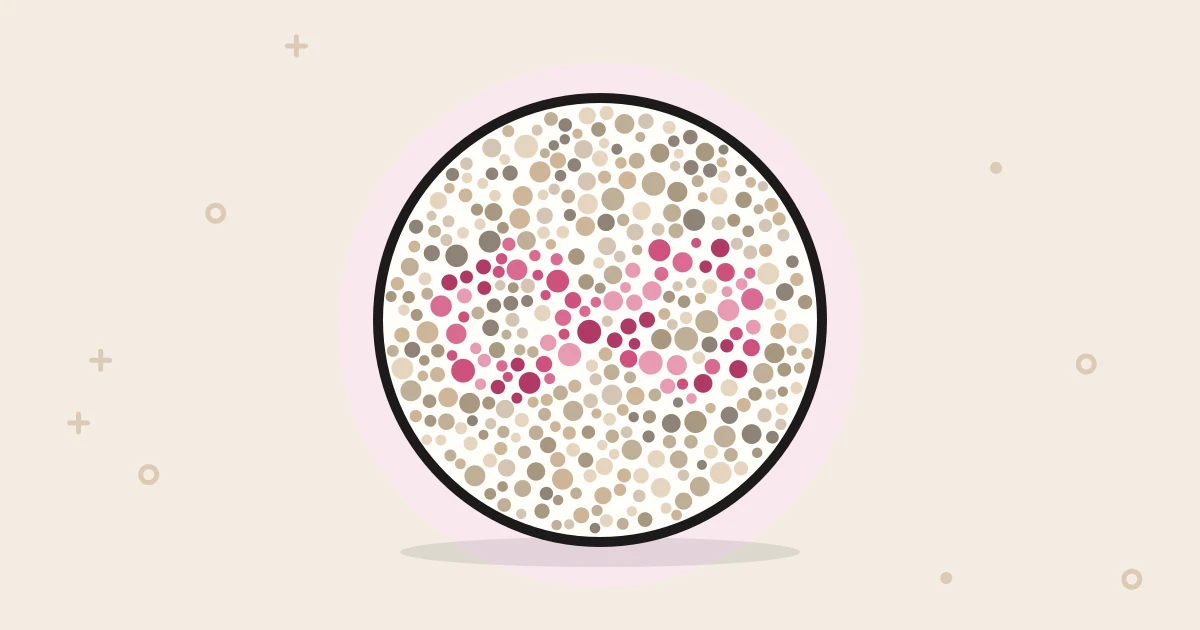
The standard screening test uses plates of coloured dots with a number or shape hidden among them. It is called the Ishihara test. People with normal colour vision see the figure. People with a red-green deficiency see a different figure or none at all. It takes a few minutes, it is painless, and versions with shapes are available for children who do not yet know their numbers.
If the screening test suggests a deficiency, more detailed tests can identify the type and how severe it is. These involve arranging coloured caps in order or matching coloured lights. Online tests can give a hint, but screen colours vary too much for a reliable result.
Boys in particular should have their colour vision checked in the early school years, and certainly before they choose subjects and careers.
When colour vision changes later in life
Inherited colour blindness is present from birth, affects both eyes equally and does not get worse. A change in colour vision that appears later is different. It can be caused by cataracts, glaucoma, diabetes, macular degeneration, problems with the optic nerve, or certain medicines.
If colours start to look faded or washed out, or look different in one eye compared with the other, book an eye examination soon. A new change in colour vision always has a cause that needs to be found.
Is there a cure? Do colour-blind glasses work?
There is no cure for inherited colour vision deficiency. Tinted "colour-blind glasses" and contact lenses filter certain wavelengths to increase the contrast between reds and greens. Some people find them helpful for particular tasks. They do not restore normal colour vision, they do not work for everyone, and they will not help you pass an occupational colour vision test.
What helps more in practice:
- labelling clothes, pens and cables
- using apps that name colours through the phone camera
- switching on the colour filter and accessibility settings on phones and computers
- good lighting, because colours are easier to tell apart in bright, natural light
- telling teachers, so that learning materials do not rely on colour alone
School, work and driving
School. Tell your child's teacher. Simple changes help: writing in black or white, labelling colours on worksheets, and using patterns as well as colours in graphs.
Careers. Some jobs have colour vision standards, including pilots, some maritime and rail roles, electricians and parts of the armed forces and police. It is far better to find out at age 10 than at a pre-employment medical.
Driving. In South Africa the eye test for a driving licence measures how sharp your vision is and how wide your field of vision is. Colour vision is not part of the legal standard. Colour-blind drivers read traffic lights by the position of the lights. See the eye test for your driver's licence.
Frequently asked questions
Can a girl be colour blind?
Yes, though it is much less common. A girl needs to inherit the altered gene from both parents, whereas a boy needs it only from his mother.
Does colour blindness get worse with age?
Inherited colour blindness stays the same throughout life. If your colour vision seems to be getting worse, something else is happening, such as a cataract, and you should have your eyes examined.
At what age can a child be tested for colour blindness?
From about age 4 or 5, using tests with shapes or pictures instead of numbers. Ask for it to be included in your child's eye test.
Can colour-blind people see traffic lights?
Yes. Most can tell the lights apart by brightness and by position: red at the top, amber in the middle and green at the bottom.
This article is general information and is not a diagnosis or a substitute for an eye examination. If you are worried about your eyes or your sight, see an optometrist or a doctor. Sudden loss of vision, eye injuries and severe eye pain are emergencies.