Short-sighted or long-sighted: what is the difference?
By See Better · Updated · 5 min read
The short answer
If you are short-sighted (myopia), near things are clear and distant things are blurry, and your prescription has a minus sign. If you are long-sighted (hyperopia), your eyes must work harder to focus, especially up close, which causes blur, tired eyes and headaches, and your prescription has a plus sign. Both are corrected with glasses or contact lenses.
Key points
- Short-sighted: you see well up close and poorly far away. Minus lenses.
- Long-sighted: close work is blurry or tiring. Plus lenses.
- Both are caused by the shape of the eye, not by anything you did.
- Long-sightedness is different from the reading blur that arrives after 40.
The quick comparison
| Short-sighted (myopia) | Long-sighted (hyperopia) | |
|---|---|---|
| What is blurry | Distant things: road signs, the board, the TV | Near things first. Distance too if it is strong |
| What is clear | Close work | Distance, in mild cases and in young people |
| Shape of the eye | Slightly too long, or the cornea too curved | Slightly too short, or the cornea too flat |
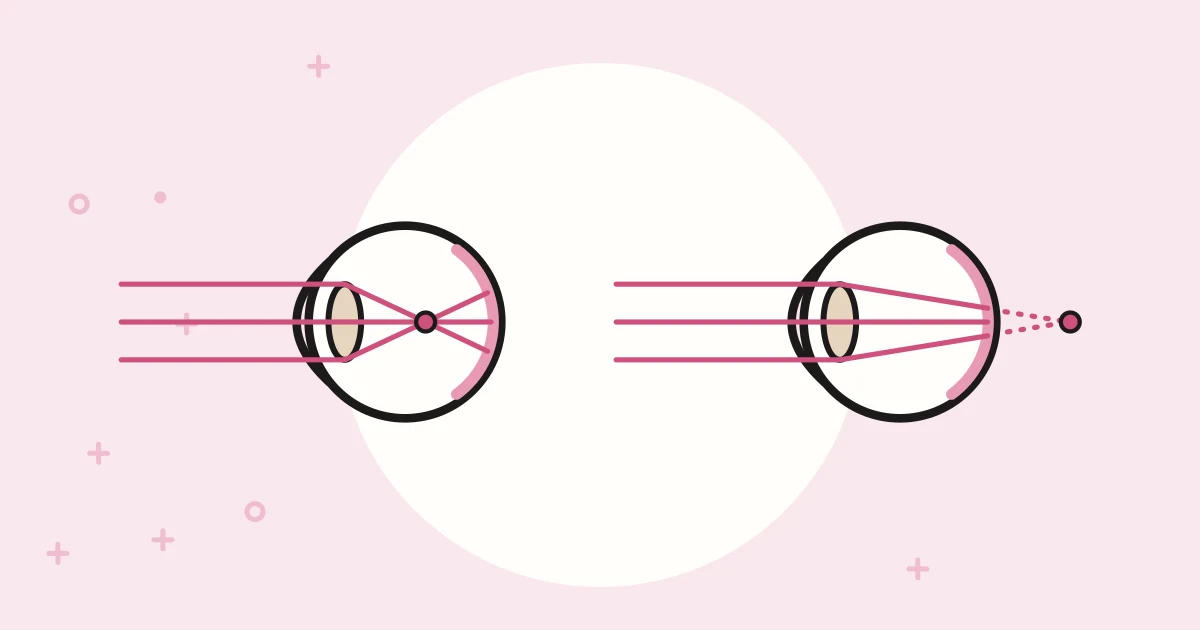
| Where light focuses | In front of the retina | Behind the retina |
| Prescription sign | Minus (-) | Plus (+) |
| Typical complaints | Squinting, trouble driving at night | Eye strain, headaches, tiredness when reading |
| Usually appears | In childhood or the teens | Present from birth, noticed later |
| American terms | Nearsighted | Farsighted |
What short-sightedness is
In a short-sighted eye, light from distant objects comes to a focus just in front of the retina, the light-sensitive layer at the back of the eye. The picture that reaches the retina is blurred. Close objects focus correctly, so reading and phone screens are clear.
Typical signs:
- road signs, number plates and faces across a room are fuzzy
- you squint to see the TV or the board
- night driving is especially difficult
- you see better when you move closer
Short-sightedness usually starts between the ages of 6 and 13 and increases through the teenage years as the eye grows. It tends to run in families, and children who spend little time outdoors are at higher risk. See short-sightedness in children.
What long-sightedness is
In a long-sighted eye, light would come to a focus behind the retina. A young eye can pull that focus forward by flexing the lens inside the eye, and it does this automatically. That is why many long-sighted children and young adults see perfectly clearly and pass a letter-chart test. The cost is that their focusing muscles are working all the time, and harder still for near tasks.
Typical signs:
- tired, aching or burning eyes after reading or screen work
- headaches, often across the forehead
- print that goes in and out of focus
- trouble concentrating on close work
- in children, avoiding reading or an eye that turns inwards
As the years pass and the eye's focusing power fades, long-sighted people notice blur up close first, and later at distance as well.
Long-sightedness is not the same as presbyopia
Both make reading difficult, and both are corrected with plus lenses, so they are easily confused. Long-sightedness comes from the shape of the eye and is present from childhood. Presbyopia is the normal stiffening of the lens with age. It affects everyone from their 40s, including people who have had perfect sight all their lives.
Can you be both?
Not in the same eye at the same time. But there are common combinations:
- one eye short-sighted and the other long-sighted
- either condition together with astigmatism, which is very common
- short-sightedness plus presbyopia after 40. This is why short-sighted people often take their glasses off to read.
How they are diagnosed
An eye test measures exactly where your eyes focus and what lens power corrects it. The result is written as a number in dioptres: minus for short-sightedness and plus for long-sightedness. The further the number is from zero, the stronger the lens. How to read your glasses prescription explains the rest of the numbers.
Long-sightedness in particular can hide, because young eyes compensate so well. If you have headaches or tired eyes but "see fine", a full eye test is the way to find out.
How they are corrected
- Glasses are the simplest solution. Minus lenses move the focus back onto the retina for short-sightedness. Plus lenses bring it forward for long-sightedness.
- Contact lenses do the same job on the surface of the eye.
- Laser eye surgery reshapes the cornea and is an option for some adults with a stable prescription.
Neither condition can be cured with exercises, diet or going without glasses. Can you improve your eyesight naturally? looks at what does and does not help.
Frequently asked questions
Is short-sighted minus or plus?
Short-sightedness is corrected with minus lenses, so the prescription has a minus sign, such as -2.00. Long-sightedness is corrected with plus lenses, such as +2.00.
Which is worse, short-sightedness or long-sightedness?
Neither is worse in itself. Both are easily corrected. High degrees of short-sightedness carry a higher risk of some eye conditions later in life, and long-sightedness that is not corrected in children can lead to a squint or a lazy eye.
Can long-sighted people see far away clearly?
Often, yes, especially when they are young and the long-sightedness is mild, because the eye's focusing muscles compensate. The effort can cause eye strain and headaches, and distance vision may also blur with age.
Does short-sightedness get better with age?
Not usually. It tends to increase through childhood and the teens and then stabilises in adulthood. After 40, short-sighted people often find they can read without their glasses, which can feel like an improvement but is a separate change.
This article is general information and is not a diagnosis or a substitute for an eye examination. If you are worried about your eyes or your sight, see an optometrist or a doctor. Sudden loss of vision, eye injuries and severe eye pain are emergencies.