How to read your glasses prescription
By See Better · Updated · 4 min read
The short answer
A glasses prescription lists the lens power each eye needs. SPH is the main power, where a minus sign means short-sighted and a plus sign means long-sighted. CYL and AXIS correct astigmatism, ADD is extra power for reading, and PD is the distance between your pupils. The bigger the number, the stronger the lens.
Key points
- Minus (-) powers correct short-sightedness and plus (+) powers correct long-sightedness.
- CYL and AXIS always go together and correct astigmatism.
- ADD is the extra reading power used in bifocal and multifocal lenses.
- A glasses prescription cannot be used to buy contact lenses.
The layout of a prescription
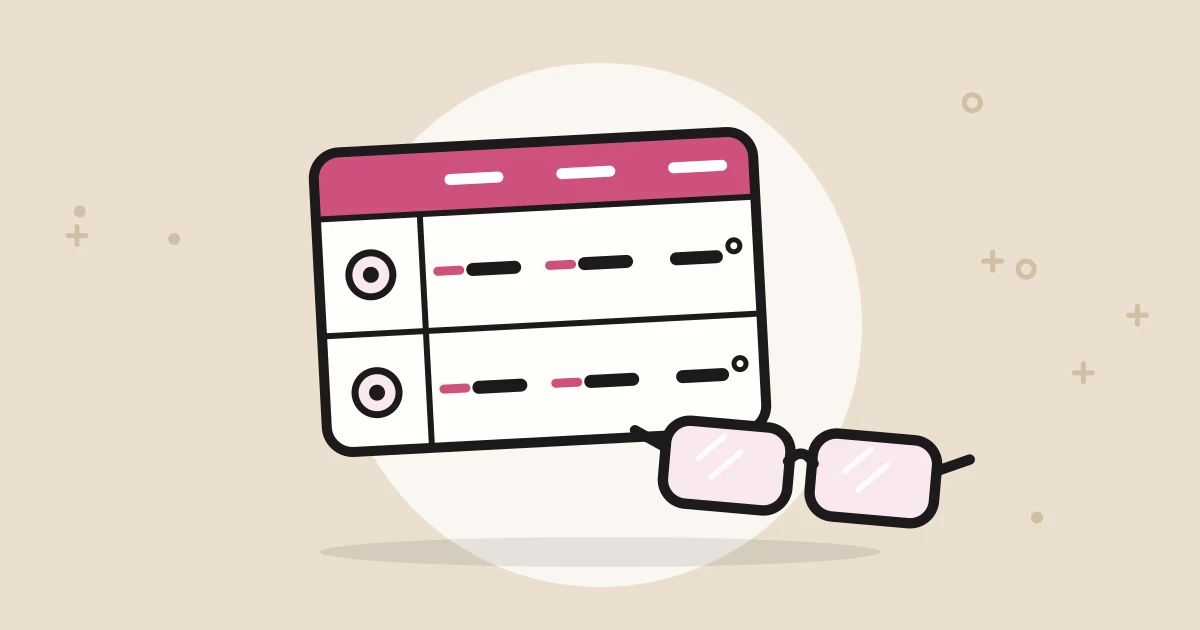
A prescription is a small table with one row for each eye. Lens power is measured in dioptres, written in steps of 0.25. A typical one looks like this:
| Eye | SPH | CYL | AXIS | ADD |
|---|---|---|---|---|
| Right (OD) | -2.00 | -0.75 | 180 | +1.50 |
| Left (OS) | -1.75 | -0.50 | 170 | +1.50 |
This person is short-sighted in both eyes, slightly more in the right, has a small amount of astigmatism, and needs extra help for reading.
Right eye and left eye: OD and OS
Some prescriptions say Right and Left, or R and L. Others use the Latin abbreviations:
- OD (oculus dexter) is your right eye.
- OS (oculus sinister) is your left eye.
- OU (oculus uterque) means both eyes.
The right eye is normally written first. It is common for the two eyes to have different numbers.
SPH: the main power
SPH stands for sphere. It is the main strength of the lens.
- A minus number, such as -2.00, corrects short-sightedness (myopia): near things are clear and distant things are blurry.
- A plus number, such as +1.50, corrects long-sightedness (hyperopia): close work takes effort or is blurry.
- Plano, PL or 0.00 means no correction is needed for that part.
The further the number is from zero, the stronger the lens. Roughly speaking, up to about 3.00 is a mild to moderate prescription and above 6.00 is considered high. For more on the two conditions, see short-sighted or long-sighted?
CYL and AXIS: astigmatism
CYL (cylinder) and AXIS always appear together. They correct astigmatism, which is when the front of the eye is curved more in one direction than the other.
- CYL is how much astigmatism there is. If the box is empty, you have none worth correcting.
- AXIS is a number from 0 to 180 that gives the direction of the astigmatism. It is an angle, not a strength, so an axis of 180 is not "worse" than an axis of 90.
ADD: extra power for reading
ADD (addition) is extra plus power added to the bottom part of the lens to help with close work. It appears from around age 40, when the eye gradually loses its ability to focus up close. It usually falls between +0.75 and +3.00 and is normally the same for both eyes. An ADD value means your optometrist is recommending reading glasses, bifocals or multifocals. Single vision, bifocal and multifocal lenses compared explains those options.
PRISM and BASE
Most prescriptions leave these blank. Prism is prescribed when the eyes do not line up perfectly, to prevent double vision or strain. BASE gives the direction of the prism: up, down, in or out.
PD: pupillary distance
PD is the distance between the centres of your pupils in millimetres, usually somewhere between 54 and 74 in adults. It tells the lab where to put the optical centre of each lens so that it sits in front of your pupil. A wrong PD can cause eye strain, particularly with stronger lenses and multifocals. It is measured when your glasses are ordered and is not always written on the prescription itself.
Is my prescription "bad"?
There is no pass mark. A prescription describes the lens that gives you clear, comfortable vision. It is not a score, and a higher number does not mean your eyes are unhealthy. What does matter is change: a prescription that shifts quickly, especially in a child, is something your optometrist will want to monitor.
Why you cannot use it for contact lenses
A contact lens sits on the eye, while a glasses lens sits about 12 mm in front of it, so the power needed is often different. A contact lens prescription also includes the lens size, curve and brand, which must be fitted by an optometrist. See contact lenses or glasses?
Frequently asked questions
What does -1.00 mean on a glasses prescription?
It means you are mildly short-sighted. Without glasses, things beyond about one metre begin to blur. Many people with -1.00 wear glasses mainly for driving, watching TV and seeing the board.
What is a normal eye prescription?
There is no single normal value. Perfect focus without glasses would be 0.00, but small prescriptions between about -0.50 and +0.50 are very common and often need no correction.
How long is a glasses prescription valid?
For adults a prescription is generally treated as current for about two years, and for children about one year. After that your eyes should be tested again before new glasses are made.
Can my prescription be different in each eye?
Yes, and it usually is, at least slightly. A large difference between the eyes is worth knowing about, particularly in children, because it can lead to a lazy eye if it is not corrected.
This article is general information and is not a diagnosis or a substitute for an eye examination. If you are worried about your eyes or your sight, see an optometrist or a doctor. Sudden loss of vision, eye injuries and severe eye pain are emergencies.