What does 6/6 (20/20) vision mean?
By See Better · Updated · 4 min read
The short answer
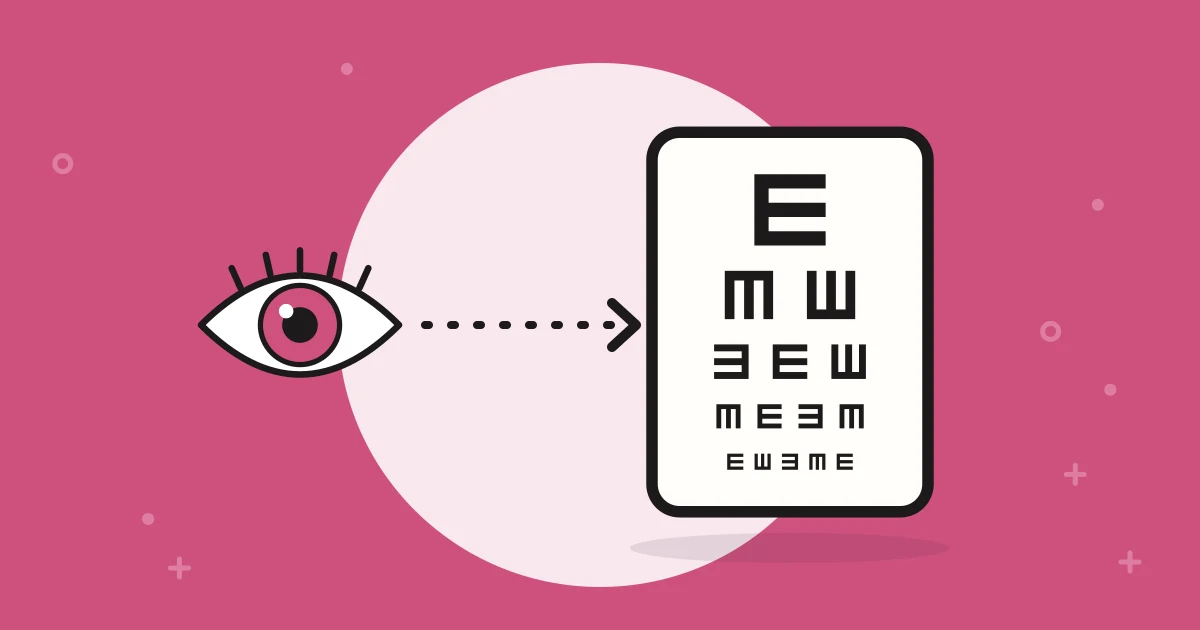
6/6 vision means you can read at 6 metres what a person with normal sight is expected to read at 6 metres. It is the metric version of 20/20, which is the same measurement in feet. It describes how sharp your distance vision is. It is not a measure of overall eye health.
Key points
- 6/6 and 20/20 are the same result, one measured in metres and one in feet.
- The larger the second number, the weaker the vision: 6/12 is weaker than 6/6.
- Many people see better than 6/6 with or without glasses.
- You can have 6/6 vision and still have an eye condition or need reading glasses.
How the two numbers work
The result comes from the letter chart used in an eye test, called a Snellen chart. It is written as a fraction:
- The first number is the distance at which you are tested. In South Africa that is 6 metres. In the United States it is 20 feet, which is almost exactly the same distance.
- The second number is the distance at which a person with normal sight could read the smallest line that you managed.
So 6/6 means that at 6 metres you read the line a normally sighted person reads at 6 metres. If your result is 6/12, the smallest line you could read at 6 metres is one that a person with normal sight could read from 12 metres away. In other words, you need to be twice as close to see the same detail.
6/6, 6/9, 6/12: how the results compare
| Metric | Feet | What it means |
|---|---|---|
| 6/4.5 | 20/15 | Sharper than the standard. Common in healthy young adults. |
| 6/6 | 20/20 | The standard for normal distance vision. |
| 6/9 | 20/30 | Slightly below the standard. Many people do not notice. |
| 6/12 | 20/40 | The minimum for a light vehicle driving licence in South Africa. |
| 6/18 | 20/60 | Distant detail such as road signs is clearly blurred. |
| 6/60 | 20/200 | Only the largest letter on the chart can be read. |
Each eye is measured on its own, and then both together, with and without your glasses.
Is 6/6 perfect vision?
No. It is the expected standard, not the upper limit. Plenty of people read one or two lines below the 6/6 line. More importantly, the chart only measures one thing: how sharp your central vision is at distance, in good light, with high-contrast black letters on a white background.
It does not tell you about:
- your near vision, which is why someone with 6/6 sight can still need reading glasses
- your side (peripheral) vision
- how well your eyes work together and judge depth
- colour vision
- how you see in poor light or against glare
- the health of the inside of your eyes
That last point matters most. Conditions such as glaucoma and early diabetic eye disease can be present for years while you still read the 6/6 line comfortably. A good chart result is one part of an eye test, not the whole of it.
What if my vision is worse than 6/6?
Most often it means you have a refractive error: you are short-sighted, long-sighted or have astigmatism. These are corrected with glasses or contact lenses, and for most people the right lenses bring vision back to 6/6 or better.
If lenses do not bring your sight up to the standard, your optometrist will look for the reason. It could be a cataract, a problem at the back of the eye, or an eye that never developed full vision in childhood, known as a lazy eye.
6/6 vision and your prescription
People often mix these up. The chart result, such as 6/9, is how well you see. The prescription, such as -1.25, is the lens you need to see better. Two people with the same chart result can have different prescriptions. To make sense of the lens numbers, see how to read your glasses prescription.
The driving standard in South Africa
To hold a licence for a car or motorcycle you need at least 6/12 in each eye, with or without glasses or contact lenses. If one eye is weaker than that, the other must be at least 6/9. Heavy vehicle and professional drivers need 6/9 in each eye. The full rules are in the eye test for your driver's licence.
Frequently asked questions
Is 6/6 the same as 20/20?
Yes. They are the same measurement in different units. Six metres is roughly 20 feet, so countries that use metres write 6/6 and countries that use feet write 20/20.
Can vision be better than 6/6?
Yes. A result of 6/5 or 6/4.5 is better than the standard, and it is common in young adults with healthy eyes, with or without glasses.
Does 6/6 vision mean I do not need an eye test?
No. The chart measures sharpness only. Eye diseases such as glaucoma can develop while you still see 6/6, so regular eye tests remain important. Most adults should have one every two years.
Is 6/9 vision bad?
Not really. It is slightly below the standard and is often easily corrected with glasses. You may notice that road signs and subtitles are a little soft, especially at night.
This article is general information and is not a diagnosis or a substitute for an eye examination. If you are worried about your eyes or your sight, see an optometrist or a doctor. Sudden loss of vision, eye injuries and severe eye pain are emergencies.